
How to Read Eye Prescription UAE: SPH, CYL, AXIS and PD


You have just come out of an eye examination with a small slip of paper covered in plus signs, minus signs and abbreviations. OD, OS, SPH, CYL, AXIS, ADD, PD. If you have ever wondered what it all means, you are not alone. Knowing how to read eye prescription UAE optometrists hand out makes it easier to talk to your optician, compare quotes for lenses and pick a frame that works with your numbers.
This guide decodes each column in plain English, shows a sample prescription, and explains which numbers matter when you choose a frame. It explains the notation only. It is not medical advice, and your optometrist is the person to confirm what your own prescription means for your eyes.
Bespecta is an online-only eyewear store, and its eyeglass frames come with blue light lenses (no power). Eyeglass frames come with blue light lenses (no power), and you can take the frame to your own licensed optician to have prescription lenses made, fitted and checked. We do not carry out eye examinations, supply prescription lenses or fit lenses.
How to read eye prescription UAE slips: the layout
Most prescriptions in the UAE follow the same international layout, whether the slip is in English, Arabic or both. There is usually one row for each eye and a column for each measurement:
| Eye | SPH | CYL | AXIS | ADD | PD |
|---|---|---|---|---|---|
| OD (right) | −2.25 | −0.75 | 180 | +1.50 | 63 (total) |
| OS (left) | −2.00 | −1.00 | 175 | +1.50 |
These numbers are an example only. Some slips write R and L instead of OD and OS, put the PD in a separate box, or leave the ADD column blank if you do not need it. A blank box or “DS” in the CYL column usually just means there is no astigmatism correction for that eye.
OD, OS and OU: which eye is which
- OD (oculus dexter) is your right eye.
- OS (oculus sinister) is your left eye.
- OU (oculus uterque) means both eyes.
The American Academy of Ophthalmology explains these Latin abbreviations in its guide on how to read an eyeglasses prescription. It is easy to mix them up, so check your slip carefully before you copy the numbers anywhere.
SPH (sphere): the main lens power
SPH, or sphere, is the main lens power, measured in dioptres (D). It usually moves in steps of 0.25.
- A minus sign (for example −2.25) is used to correct short-sightedness, where distant things look blurry. The NHS explains this in its page on short-sightedness.
- A plus sign (for example +1.75) is used to correct long-sightedness, where close things are harder to focus on. See the NHS page on long-sightedness.
The further the number is from zero, the stronger the lens. A higher number does not tell you anything about eye health on its own, so do not try to interpret it beyond that. Ask your optometrist.
CYL (cylinder) and AXIS: astigmatism correction
CYL, or cylinder, is the extra power used to correct astigmatism. Astigmatism usually means the front of the eye is shaped more like a rugby ball than a football, so light focuses unevenly. The American Optometric Association has a clear explainer on astigmatism.
AXIS always comes with CYL. It is a number from 1 to 180 that tells the lab which direction to orient the cylinder power in the lens. It is an angle, not a strength, so an axis of 180 is not “worse” than an axis of 90. If your slip has a CYL value, it should also have an AXIS value for that eye.
Some optometrists write the cylinder as a minus number and some as a plus number. Both describe the same correction in different ways, which is one more reason to give your optician the slip itself rather than retyping it.
ADD: extra power for reading
ADD is the added magnifying power at the bottom of a multifocal lens, used for reading and close work. It is always a plus number, usually between +0.75 and +3.00, and it is often the same for both eyes. ADD commonly appears from around your 40s, when presbyopia makes close focusing harder. The AOA explains this in its page on presbyopia.
If you have an ADD value, your optician will discuss options such as reading glasses, bifocals or progressive lenses with you. That lens choice is theirs to advise on, but it does affect your frame: progressive lenses generally need enough lens depth to fit the reading area, so mention it before you choose a very slim or shallow frame.
Prism and BASE
A few prescriptions also have a PRISM column with a BASE direction (up, down, in or out). Prism is used to help the eyes work together. It is less common, and if your prescription has it, your optometrist and optician should handle the details with you.
PD (pupillary distance): the frame-fitting number
PD, or pupillary distance, is the distance between the centres of your pupils in millimetres. Adult PDs are often somewhere around the low to high 60s, but yours is your own. It may be written as one number (for example 63) or as two “monocular” numbers, one for each eye (for example 31.5 / 31.5).
PD is what your optician uses to place the optical centre of each lens in front of your pupil. It is not always printed on the prescription. If yours is missing, ask your optician to measure it when you take in your frame for lenses, rather than guessing.
What your prescription means when you choose a frame
Your prescription does not pick a frame for you, but a few points are worth discussing with your optician before you buy:
- Stronger prescriptions. Higher SPH or CYL values can mean thicker lens edges. Ask your optician how a frame’s lens size might affect thickness, and whether a smaller lens could help.
- ADD and progressives. If you have an ADD value, ask how much lens height your optician needs. Very shallow frames may not suit progressive lenses.
- Frame size versus PD. A frame whose lens centres sit close to your pupils is easier to fit well. Every Bespecta product page lists the frame size as lens width, bridge and temple length in millimetres, for example 55-17-145.
- Comfort. If you wear glasses all day, a lighter frame is easier to live with. Our titanium glasses guide compares frame weights in grams.
Not sure which shape or width to start with? The free FrameFit tool suggests your face shape and frame width from a photo, and our guide to the best glasses for a round face covers shape matching in detail.
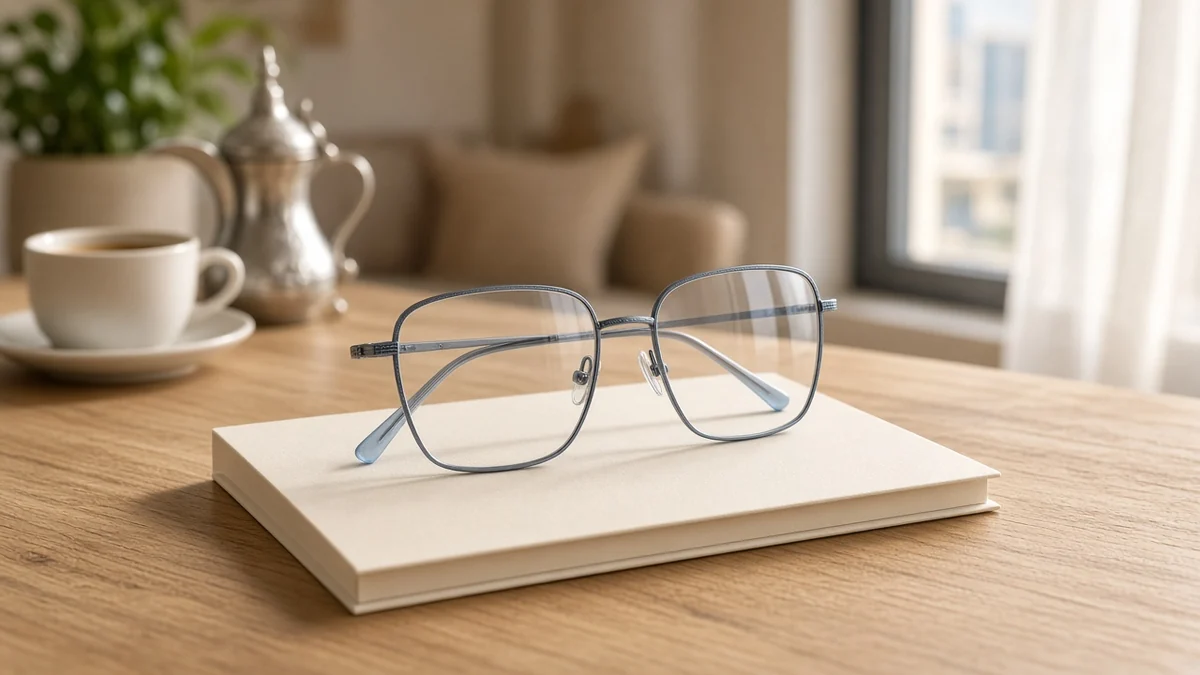
Frames on Bespecta to take to your optician
All prices below are the sale prices shown on each product page on 15 October 2026, including 5% VAT; the price covers the frame with blue light lenses (no power), and prescription lenses from your optician are extra. Lens costs are set by your optician. For a full budget, read Prescription Glasses Dubai Price.
- Bazeti HF6003 Titanium Square, AED 349. A slim square titanium frame with adjustable nose pads, sized 55-17-145 and weighing about 16 g. Black, Grey and Silver are in stock. A versatile everyday frame with a regular lens depth.
- Bazeti FC3012 Titanium Round, AED 349. About 14 g with ultra-slim rims and adjustable nose pads, labelled Narrow (52-18-145). Black and Silver, Black and Rose Gold, and Grey and Silver are in stock.
- Bazeti M1106 Clip-On Square, AED 349. An acetate square frame with a magnetic sunglass clip, so one pair of prescription lenses can serve indoors and out. Black-Gold and Brown are in stock at the time of writing.
- Bazeti TR5101 Kids Square, AED 149. A flexible, lightweight frame for children, in Black, Blue, Dark Green and Light Green. See the full kids range.
You can also browse all titanium frames.
Ordering a frame from Bespecta, step by step
- Keep your prescription handy and check whether a PD is written on it.
- Choose a frame and compare its lens width, bridge and temple to a pair that already fits you, or use FrameFit.
- Order online. Delivery is free to all emirates, with no minimum order. Cash on delivery is free, or you can pay with Tabby in 4 payments.
- Try the frame on with the blue light lenses it comes with.
- Returns: only if the item is defective or not what you ordered, unused, in original packaging, within 7 days of delivery, via WhatsApp.
- Take the unused frame and your prescription to your optician to have prescription lenses made and fitted. Once lenses are fitted, the frame is no longer unused, so be sure of the fit first.
Questions about a frame’s size? Contact our team or WhatsApp +971 54 364 3033. We can help with frame measurements, but questions about your prescription itself belong with your optometrist.
FAQ
What do SPH, CYL and AXIS mean on an eye prescription?
SPH (sphere) is the main lens power in dioptres. A minus value is used for short-sightedness and a plus value for long-sightedness. CYL (cylinder) is extra power for astigmatism, and AXIS is the angle from 1 to 180 that tells the lab how to orient that power. Your optometrist can confirm what your own values mean.
What is the difference between OD and OS?
OD is your right eye and OS is your left eye. OU means both eyes. Some UAE prescriptions simply write R and L instead.
Is PD always on my prescription?
Not always. PD (pupillary distance) is the distance between your pupils in millimetres, and some slips leave it out. If yours is missing, ask your optician to measure it when you take your frame in for lenses.
What does ADD mean?
ADD is extra magnifying power for reading and close work, used in bifocal or progressive lenses. It is always a plus number. If you have one, tell your optician before choosing a very shallow frame.
Can Bespecta make lenses for my prescription?
No. Bespecta eyeglass frames come with blue light lenses (no power). Eyeglass frames come with blue light lenses (no power), and your own licensed optician makes, fits and checks your prescription lenses. We also do not carry out eye examinations.
Can I return a frame after prescription lenses are fitted?
No. Once prescription lenses are fitted, the frame is no longer unused and cannot be returned. If a new, unused frame arrives defective or is not the item you ordered, it can be returned in its original packaging within 7 days of delivery: message us on WhatsApp at +971 54 364 3033 with your order number.